Thursday, 13 March 2008

"I was hungry, and you fed me"

The Barnabas Fund has launched its Easter appeal - food for persecuted Christian minorities in Muslim countries.
"In today`s world, poverty, hunger and sickness are a reality for many of our Christian sisters and brothers. In a country in the Middle East, Christians are a despised minority. They daily face discrimination, harassment and even the possibility of violence. Most Christians in this country (which cannot be named as it would endanger them) live in desperate poverty. Their homes are ramshackle and inadequate; they might not have any flooring, and their roofs often let in the winter rain. They struggle to find work as people do not like to employ Christians. There are Christian children so poor that they do not know what an egg is, because they have never seen or eaten one."
Here's a question for Christians today. In Matthew 25:40 Jesus says, "Truly I say to you, inasmuch as you have done it to one of the least of these my brethren, you did it to me." Who in the world right now, if not these persecuted believers in Islamic countries, counts as "one of the least of these, [Jesus'] brethren" ?

Read more and donate here: http://www.barnabasfund.org/email/email.php?id=125

Biblical wisdom, Biblical folly

What does it mean to be wise, and what does it mean to be foolish?

In the modern west, we're trained to think of these things in terms of "cleverness". Professor Boffins is wise, for he has many letters after his name. The Bible, though teaches something radically different.

In Biblical terms, the foolish person is not the slow person. It is rather the person who leaves God out of their thinking. On the other side of the coin, the wise man is the person who begins his thinking with his Maker. The two classic verses on these subjects are these:
"The fear of the LORD is the beginning of knowledge: but fools despise wisdom and instruction." - Proverbs 1:7
"The fool has said in his heart, 'There is no God.'"- Psalm 14:1
To modern secular thinkers, this itself sounds foolish. To the modern secularist, "religion" is something personal, private and doubtful. The philosophers, theologians and others can discuss it - but it's something of a side-issue as far as the daily mechanics of life are concerned.

Given, though, the reality of God, the Bible's teaching on wisdom and folly is actually the only thing that can fit with it. Modern secularism is really atheism in a poor disguise. Given that we are created and live in a created universe, sustained at all times by our Maker - what could be more stupid than to treat him as irrelevant or a debatable point? In him we live, move and have our being. We cannot keep our own souls alive; he is the basis for all the essential phenomena of human life: our existence and consciousness as personal, willing and acting moral beings: maker, sustainer, provider and final judge. It follows as night follows day that wisdom means to walk in his fear and to seek him. To behave as if we are independent of him is the highest foolishness.

The Bible, then, treats wisdom and folly not as intellectual matters but as moral ones. You can be a professor at Oxford University and yet one of the most foolish men on the planet. Which brings us on to the Bible's explanation of just why people like Richard Dawkins take the stance they do. Psalm 14:1, begun above, continues as follows:

"They are corrupt, they have done abominable works, there is none that does good."

God's word traces the human tendency to leave him out of our thinking to a prior moral failure. We say "no God" and act that way, because we want to. We desire there to be no God: we wish to act autonomously, as if we were answerable to no-one. It suits us to call ourselves "boss", and do as we feel is best for our own interests. It's hard, though, to fight against our created nature. The leopard can't remove his spots, and we can't actually achieve the autonomy we wish existed. Why do Professor Dawkins and those of his ilk get so angry about the being who they say has no existence? Would it make sense for me to lose my rag about how my wife burns my dinner every day - whilst also insisting that I'd never been married? I think not!

True wisdom is to submit to God in Jesus Christ. The Bible's explanation of wisdom and folly exposes the fact that it's not just Dawkins & co. who have a problem with folly. The roots of it lie in all our hearts, though expressed in different ways. True wisdom today means to live deliberately and self-consciously for the honour of your maker, and to believe in his Son, receiving forgiveness and power from him to live in a God-pleasing way.

Wednesday, 12 March 2008

The Need To Speak Clearly!

Last Easter, radio presenter Adrian Chiles explained why he had become a Roman Catholic:
"Last Easter there was an article in The Spectator," he tells me. "It asked loads of people whether they really believed that Christ died and physically rose to heaven? Tony Blair said he didn't talk about religion, Ann Widdecombe said something or other, the Archbishop of Canterbury came up with some theological stuff I didn't understand. The only manjack who didn't seem to equivocate was Cardinal Cormac [Murphy-O'Connor], who said something like 'Yes, of course. Full stop.' And I thought: 'That's it! If you're going to believe in any of it you might as well believe in the whole lot.'"
2 Corinthians 3:12 says: "Seeing then that we have such hope, we use great plainness of speech:". Christians have a message to communicate. Not to pontificate over; not to twist; not to apologise for - but to communicate. Many modern people realise the emptiness and fruitlessness of secular humanism.  Such people realise that the liberal perversion of Christianity espoused by such as the Archbishop or Tony Blair has nothing to offer them, because it is really little different in practice to secularism with a thin varnish of Christianity on top.  Such people, though, are ripe pickings for false religions and cults, whose members are ready to communicate with clarity and make a cogent criticism of modern unbelief. What a tragedy if such hungry souls never hear a clear and forthright presentation of the true gospel and end up having to choose between liberal waffle or a false salvation-by-works system instead.

Christians and particularly preachers - can you say that you, when explaining the gospel, use "great plainness of speech" ?

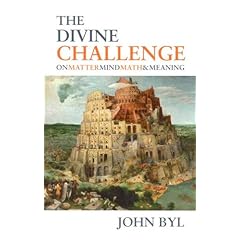
Book Review - John Byl: The Divine Challenge on Matter, Mind, Math and Meaning

A few months ago I gave a presentation entitled "Is belief in divine creation rational?", which you can listen to on-line.

In that talk, I concentrated on one particular line of argument. Consistent materialists ultimately have nothing to say to us - because consistent materialism can easily be shown to be unable to explain the basis for the very acts of rational discourse and logical argumentation. The very manner in which they go about their business - assuming before they begin in the reality of consciousness, minds and rationality - refutes them. Turning this around, we have a solid proof for the reality of God who has made us in his image, the so-called "transcendental argument" - because if you assume anything to the contrary, you have no basis on which to prove anything else at all.

Well as I say, that's all covered in my presentation. This blog post is a book review, of John Byl's "The Divine Challenge: On matter, mind, math & meaning". I had not heard of Byl's book at the time I gave my talk, and wish I had, because it would have been ideal to recommend afterwards when I was asked for further reading material.


John Byl is Professor of Mathematics and Head of the department of Mathematical Sciences at Trinity Western University, British Columbia in Canada. He has a Ph. D. in astronomy from the University of British Columbia. In this book, he seeks to make a comprehensive overview of naturalism and its power (or not) to explain reality, particularly in relation to the three inter-related "worlds" of matter, mind and mathematics.

I am convinced that this is the territory which theists today need to concentrate on if they are to succeed in rebutting the arguments of atheists. When we talk about these issues, we begin challenging the foundations of the atheist world-view. It is a common debating ploy, and a superficially plausible one, for today's atheists to say "we shall not believe in a God until his existence is rationally proved to us; as yet, we find all such proofs lacking, and hence we do not believe." This is to make atheism the default, and to excuse it the task of having to justify its own set of assumptions and their implications - including the foundations for the very concept of a rational proof. Once theists start talking about these things, the atheist soon finds himself in very big trouble. If you've never heard an atheist utterly dismantled using this method, then you should be downloading Professor Greg Bahnsen's audio debate with Professor Malcolm Stein - The Great Debate - Does God Exist?, or reading Douglas Wilson against Chrishopher Hitchens.

I've learnt a lot by reviewing debates including the ones above. Byl, though, has practically provided us with a primer for the theoretical material behind such debates. Like myself, Byl is a mathematician by training (though unlike myself he's one with a professorship!). I've found that mathematics can be something of a closed world to outsiders, and few understand its fundamental significance in the universe. Byl unfolds it masterfully, explaining the intimate and yet inexplicable (from a naturalist point of view) connections between it and physical reality. Mathematics appears from one angle to be entirely abstract. Throughout history, its practitioners have discovered concepts and theorems which appear to have no even remotely possible connection to material reality. But, time and again, those discoveries have later been found out to be reflected in a very profound way in the physical universe. Some mathematical discovery of the past has suddenly been found to be a key to understanding some empirical phenomenon, and a new advance has been made in one of the physical sciences.

Then there is the connection between matter and the mind. What is consciousness? How can it be accounted for? On what basis can we expect our minds to be reliable? What is the connection between our abstract thoughts and reality? How can our minds influence the physical world? What is the connection between the mind and the brain? What is the cause of our thoughts? What about free will? How is it that our minds apparently have the capacity to understand reality, and how can this be accounted for? What is chance, and in what sense can it be said to be a cause of anything? Byl discusses these and a whole host of related issues in a scholarly yet easy to read style. His research is comprehensive - the bibliography of works cited runs to 11 pages, and I never got the impression that Byl had cited a work other than because it advanced the argument he was making. The authors quoted run from Calvin to Chomsky, and Darwin to Derrida.

Byl asks a lot of questions which will make the read think, "Why have I never asked that?" Today's Internet atheists take enormous number of things for granted, but they are not alone - practically everybody does; without doing so, we couldn't get on with life. Byl unpacks the concept of a "worldview" as an interpretative grid for explaining reality, and then discusses the tests which can be applied to worldviews in order to test their relative strengths and weaknesses. The core of the book is as he then applies these tests to naturalism. Can naturalism account for all the things which we take for granted. Again and again, Byl surveys the lie of the land, and then gives us the naturalists present conclusions on the matter - again and again, concluding either that some phenomena (consciousness, mathematics) is either inexplicable and that we must place our faith in some future discovery, or that that phenomena will have to be written off as illusional and not an actual part of reality. Here's Francis Crick, one of the men who discovered the structure of DNA, on the origin of life:

An honest man, armed with all the knowledge available to us now, could only state that in some sense, the origin of life appears at the moment to be almost a miracle, so many are the conditions which would have to be satisfied to get it going. (p92)
And here he is again, dismissing individual identity, minds and consciousness and much else besides as mere illusion:
The Astonishing Hypothesis is that "You", your joys and your sorrows, your memories and your ambitions, your sense of personal identity and free will, are in fact no more than the behaviour of a vast assembly of nerve cells and their associated molecules. (p7)
Byl makes the point very effectively that if naturalism has (as indeed it does), to ultimately write off almost every aspect of reality as either inexplicable or illusional, then this really amounts to no more than saying that naturalism is a non-starter when it comes to explaining reality. Any worldview which cannot account for the irrefutable facts of existence, is not a worldview which a person can rationally embrace.

Byl gives further consideration to viewpoints from beyond naturalism, briefly examining postmodernism and existentalism. This section is briefer, but he does enough to show their self-refuting nature. The remainder of the book is taken up as Byl rises to the challenge of demonstrating that Christianity gives a coherent explanation of the various phenomena which he has described. The Bible's view of a triune God who has created all things and created man in his image is shown to be the ultimate Ockham's razor: it requires none of the dodges or despair that naturalist writers end up in, but gives a credible account of the various phenomena relating to minds, matter and mathematics and the various inter-relations between them. More than that, it also explains, through the Bible's history of mankind's rebellion against God and original sin, why naturalists are so keen to chose another explanation! Byl is also helpful in explaining that Christianity is though vastly more than a mere system of correct philosophy; it is God's loving plan to save us and to bring us to know him, through Jesus Christ.

I appreciated this book particularly as a mathematician. When I was at university, I observed that the proportion of atheists was very low amongst the "mathmos". Mathematicians are by default realists in their work - approaching new theorems as discovery, not invention. Mathematics, in its apparent structure, elegance and universality resists naturalism at a very fundamental level, and Byl's book refreshed me by explaining how that was so in a very straightforward way.

I heartily recommend this book. It examines deep issues in an intellectually honest and thorough way, in words and at a pace that should not be beyond any reader. Byl is easy to follow; he has a deep enough grasp of what he's talking about to be able to explain it all simply. I suppose that this book won't be known about in many circles due to it being published by a Reformed Christian publisher - I hope that this review of mine will give it more of the publicity it deserves.

Go to Amazon (UK).

David Anderson

(Re-posted from http://intelligent-sequences.blogspot.com)

The Federal Vision And The Language Of Appearance (End)

Part one, part two, part three, part four, part five, part six, part seven

I said, "to be concluded". In fact, I don't think there's anything more that needs saying. There were just two verses I forgot to reference which I think bear out my point that Arminians have a much better position if we're going to accept the hermeneutic that the Federal Visionists have used here:

"But if your brother is grieved by your food, you are not walking charitably. Do not destroy him with your meat, for whom Christ died." - Romans 14:15

"And through your knowledge shall the weak brother perish, for whom Christ died?" - 1 Corinthians 8:11

"See," says the Arminian, "Christ died for him, he's a real brother, but he ends up perishing. Christ can die for someone, and he can be lost. You have to twist the text to avoid the conclusion." I would be interested to read how an FV proponent exegetes this verses, avoiding the Arminian conclusion yet defending the propriety of using the same hermeneutic on other verses such as Matthew listed. I haven't looked very far to see how they do this, but I think these verses would make an excellent text case of whether they're willing to follow their method to its logical conclusions or not.

(The end!)

Tuesday, 11 March 2008

Why is prostitution criminal and/or public?

The governor of New York has apparently been caught being involved in a prostitution ring, and will likely end up resigning.

Secularists often state that sexual morality is private, and should be kept separate from public life - who's hurt when a man pays for sex?

Answer: Sexual conduct is not private. The basis of solid society is a public sexual relationship - between man and wife. The state rightly publicly recognises such relationships, and not others (a man can't marry a boy (yet!)). If the state publicly approves of one sort of sexual relationship, then it must be definition be disapproving of others. To say that sexual conduct is private and the state can't be involved is a position which logically leads to sexual anarchy. If the state can't disapprove of prostitution, then there's no logical stopping ground before we say that it can't disapprove of the man-boy love league, or a man marrying three wives and two husbands, or a goat. If sex is just about personal preference, then your preferences are just as good as anyone else's, no matter how perverted. Secularists can't have your cake and eat it. I've spent a bit of time criticising the state for poking its nose into things that aren't its business - but sex is its business.

New York governor Eliot Spitzer made a public vow, recognised by the state, to forsake all others except his wife. When a man flangrantly breaks such a vow, he can't suddenly claim that it's not public after all.

Those Genealogies

Two facts:
  • The Bible has a lot of genealogies.

  • God gave us all the Bible, and so wants us to read it all.
One conclusion:
  • God wants us to read lots of genealogies!
What value then can we find by reading genealogies?
  • Most - almost all - appear in the Old Testament. The main purpose is Christological.

  • That is, God has taken great care to record an accurate history leading up to his Son. He gave many increasingly specific promises - son of the woman, son of Abraham, Isaac, Jacob, of the tribe of Judah, son of David - and has taken corresponding care to record how it eventually happened.

  • That's why the New Testament doesn't record any more genealogies after Matthew and Luke's account of the lineage of Jesus.

  • Therefore, we must always remember that in the Old Covenant we are reading about God's preparations for the sending of his Son. We are being reminded that the coming of Jesus is the great, supreme fact of history. It was purposed, planned and accomplished with minute precision. Fantastic!

  • The genealogies therefore are continually reminding modern Christians that Christianity is not and never has been mere "values". It is not what secular people like to think of religion as - something private, personal and that should not intrude into our public lives or relationships, which would be offensive and/or medieval. Nope: from the beginning, God has been working in real human history, time and space, to prepare for the coming, dying and rising again of his Son. Christianity is something for this world, not an imaginary upstairs world that we don't live in.

  • Jesus Christ is the only one individual in modern times (where "modern" is used as a relative term!) whose entire descendency from the very beginning of human history can be traced out (except of course for his half-brothers, etcetera - but of course that's because of him). His uniqueness is exemplified by the amazing detail in which his ancestry was recorded. Who was Muhammed? Buddha? Where did they come from? Were we meant to be expecting them? In the case of Jesus Christ, we can trace him right down from Adam - we need not be in any doubt that he was the Messiah.

  • Each individual name was in almost all cases almost nothing in itself - we know nothing about almost all of them. But they all played their part in the whole. No life is without meaning or purpose - all play their part in God's plan for history, and lead to the fulfillment of his purposes.

  • The incredible historical detail and precision (especially as we see all the historical accounts tie up with each other) can give us great confidence. The Bible has the "ring of truth". It is clearly presented as something that its authors went to great pains to ensure the detailed accuracy of, that we might know with confidence in whom we have believed. No forger could produce something like the genealogies of the Bible.

  • The genealogies remind us that our names are all known, individually and personally, to God. When gone, we are not really gone and not forgotten - God will one day open the books again and call us to account for our lives in judgment.

  • The genealogies also humble us, not only by their Christo-centricity. Some of the names in them would have been very great names in their own day - but now we know nothing at all about them. So it will be one day with almost every single one of us - maybe the next US president's name, whether McCain, Clinton or Obama, will be recorded 4000 years from now should the Lord tarry and known to the specialists - but unless they start a nuclear war, that'll be about it. As for me and you, will we be thought about even once when our contemporaries have passed away?

  • Hence, the genealogies encourage us to focus on Jesus and his kingdom. Our names will perish, but his work will continue to advance. His name will be remembered, and maybe in 4000 years time someone will be saying something very much like this! Nothing we do for Christ will be in vain (1 Cor. 15:58); nothing we do for our own names will ultimately have any lasting value. So serve him!

Feel free to fill the comments with any other helps you can think of that we can get from the genealogies.